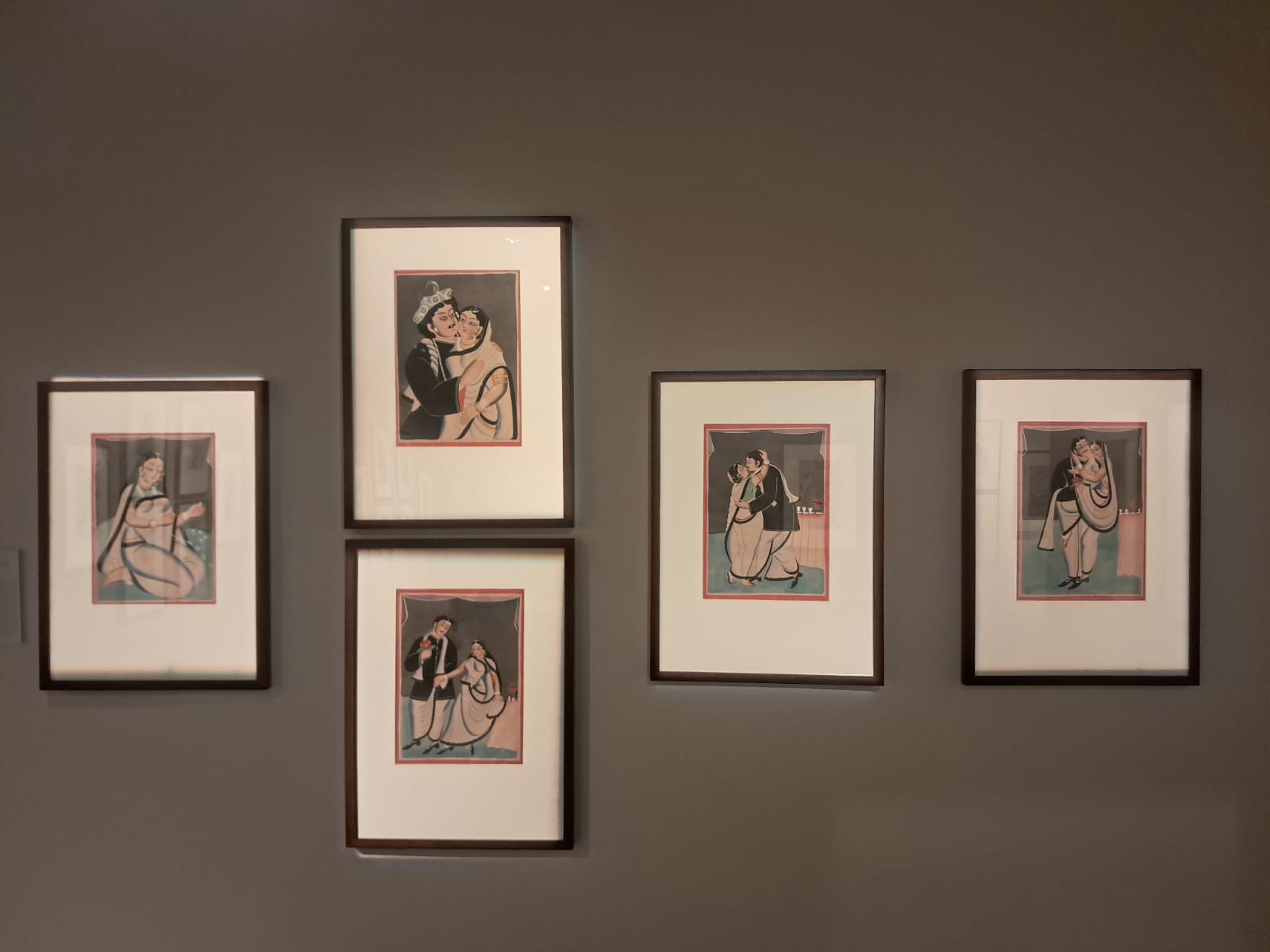
How often do you find the so-called ‘High Art’ displayed alongside local craft practices in a single gallery space, all telling the story of a single city spanning over a century? This is what took place at the Babu & Baazar exhibition, organized by DAG (Delhi Art Gallery) at the Alipore Jail Museum, Kolkata.
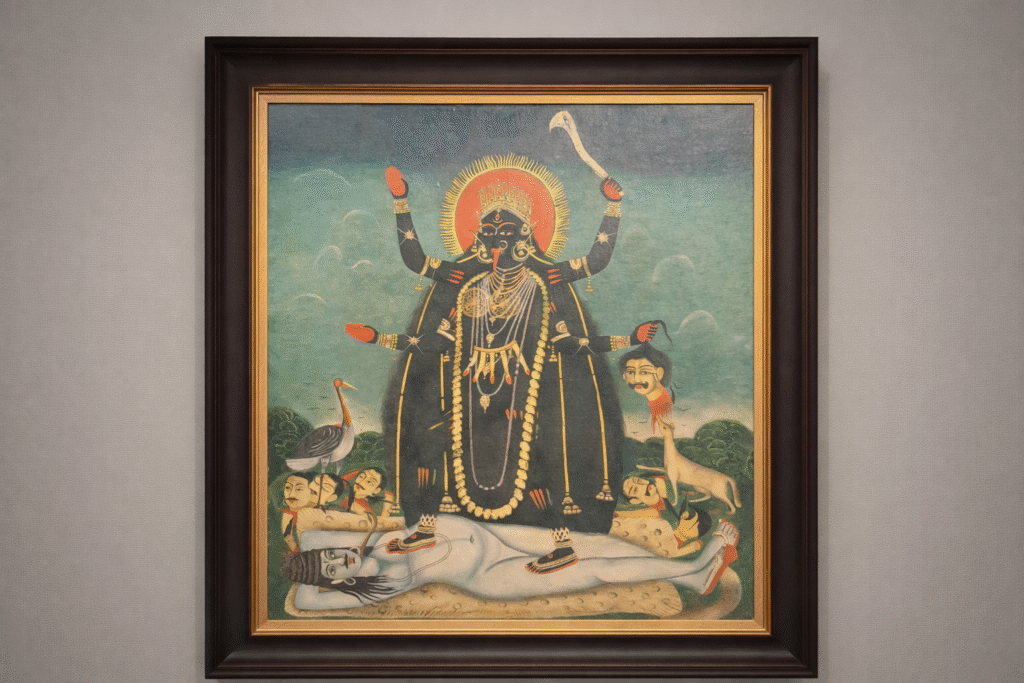
Oil highlighted with gold leaf 29.0″X23.7″(artist unknown)
The ode to the city rightly begins with devotional oil paintings depicting icons of Goddess Kali, episodes of Krishna Leela, and icons of Goddess Durga, as remnants of the tantric, Shakti, and Vaishnav traditions that had gripped different parts of medieval Bengal. The series of devotional oil paintings then gives way to Kalighat paintings, which, like modern souvenirs, were bought by the earliest Jesuit Priests as symbols of an unknown faith.
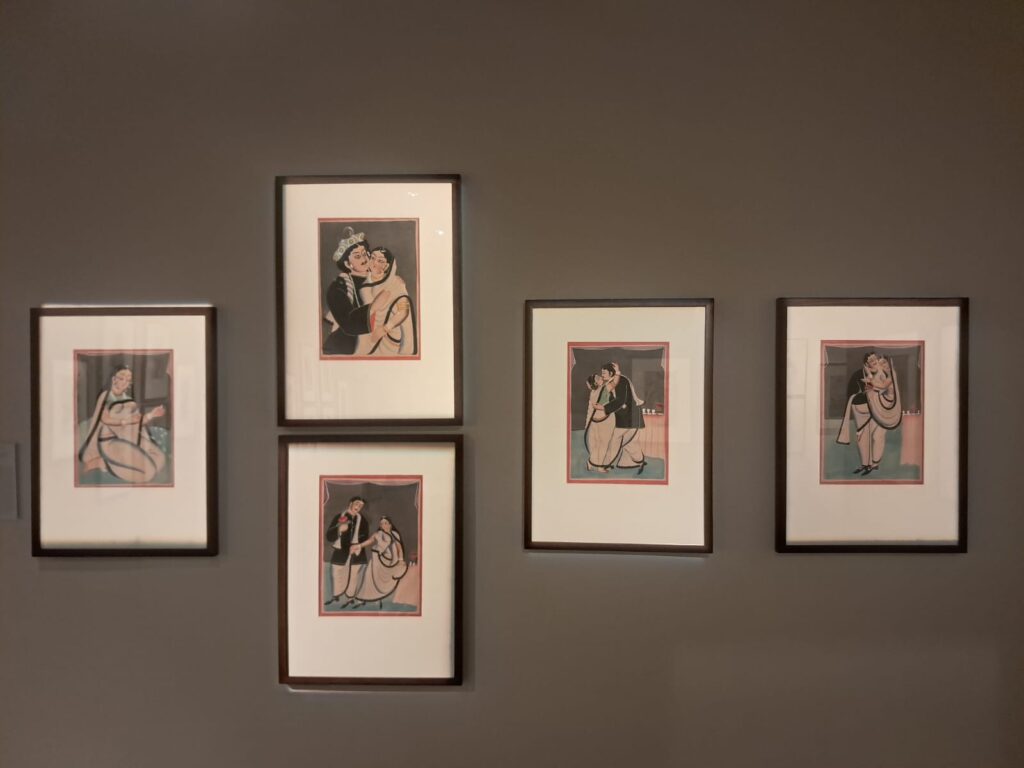
Watercolour on Paper(15.7″x11.2″)
The paintings, which started with deities as a subject, soon turned into caricatures of the modern-day tabloid press, capturing the upper-class men vulnerable in their bedroom, beaten up by their wives, or succumbing to the charms of a ‘fallen woman’. These paintings are a splendid study of Art rendering a voice to the powerless.
Unforgettable are those dramatic mythological paintings depicting episodes from the Ramayan and the Mahabharat, in the same light as Neo-classical European Art depicted episodes of Greek Epics. Detailing in the painting of the disrobing of Draupadi, modelled after the painting of the Darbar of Mysore.
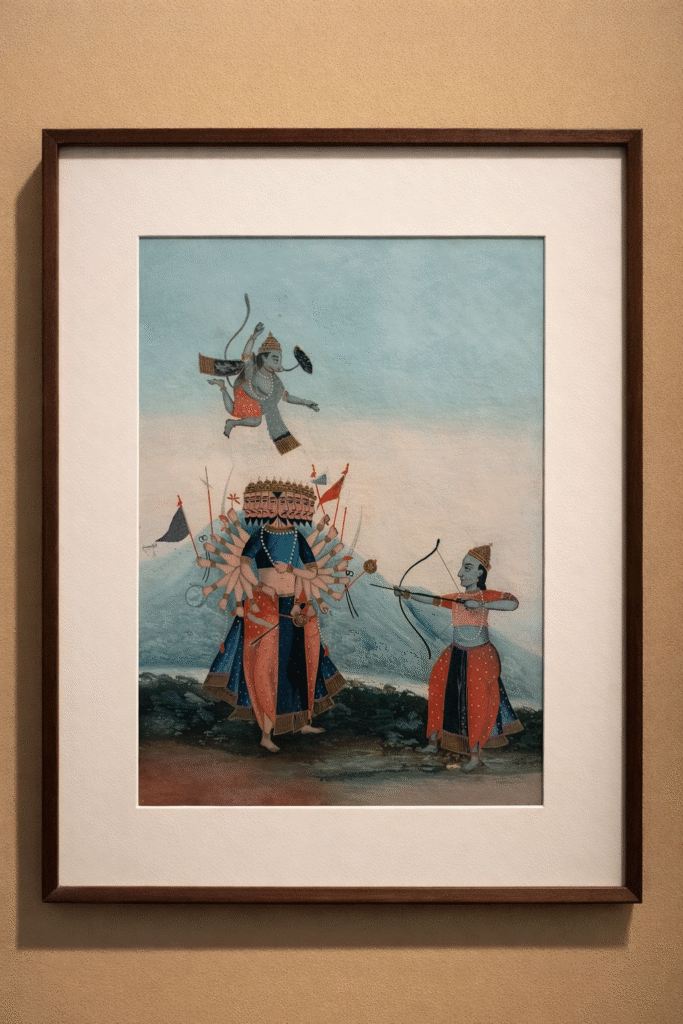
Gouache, highlighted with gold pigment on reverse glass
The next is a series of Cantonese glass paintings washed in a dreamy translucent turquoise with a popping scarlet colour. Depicting mythological episodes but in Chinese artistic vocabulary, like conical crowns on Ram and Ravana or spiral clouds, spiraling moustaches of fishes and dolphins. This would be a visual treat for Anime lovers.
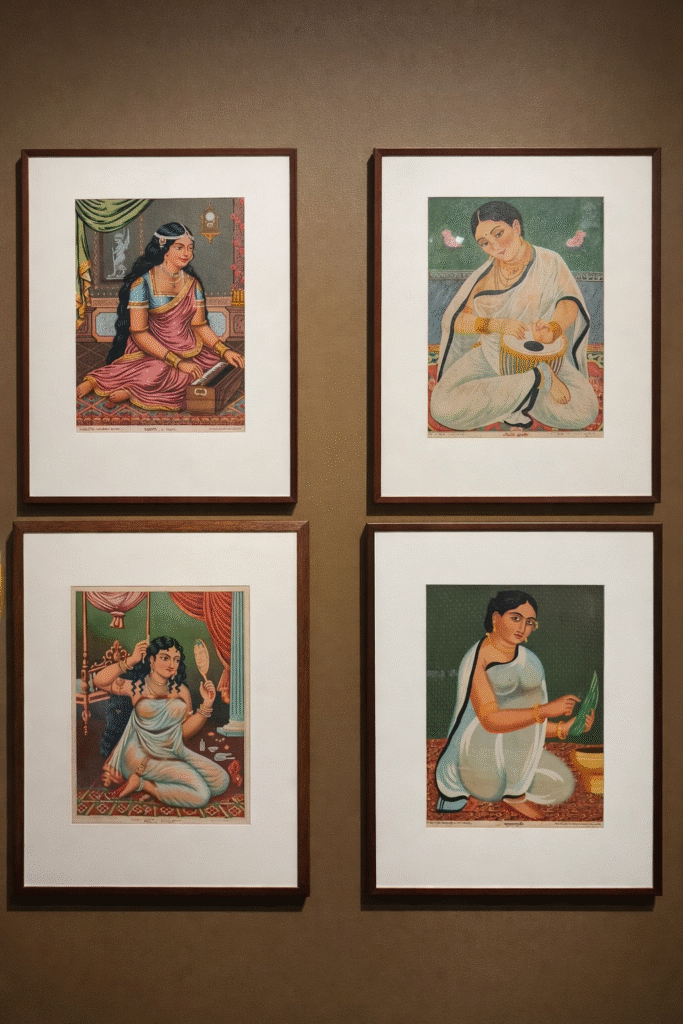
Lithograph
At the turn of the 19th Century, as printing technology developed, printing presses like the Calcutta Art Studio, the Chorebagan Art Studio, and the Jubilee Art Studio made prints depicting deities and mythological episodes as accessible to the masses as a Kalighat painting, but with the anatomical precision of a European High Art.
To experience the social, technological, and economic change in Bengal through colonial Bengali Art, visit the Babu & Baazar Exhibition on view at the Alipore Jail Museum,till 3rd January.
Leave a Reply