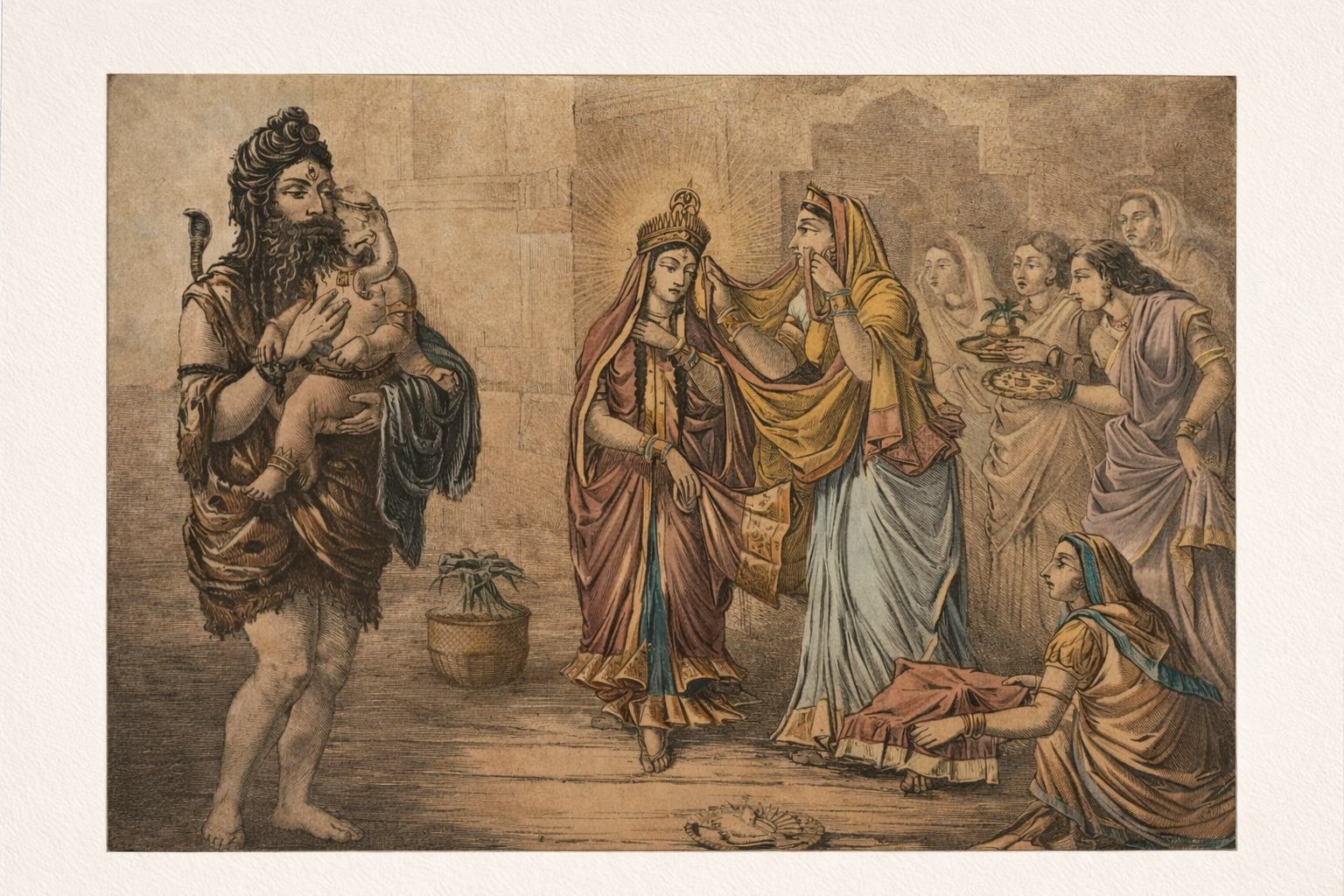
I’ve chosen three of my favourite works of Art from the ongoing exhibition Babu & Baazar at Alipore Jail Museum.
Kumoda Sundari
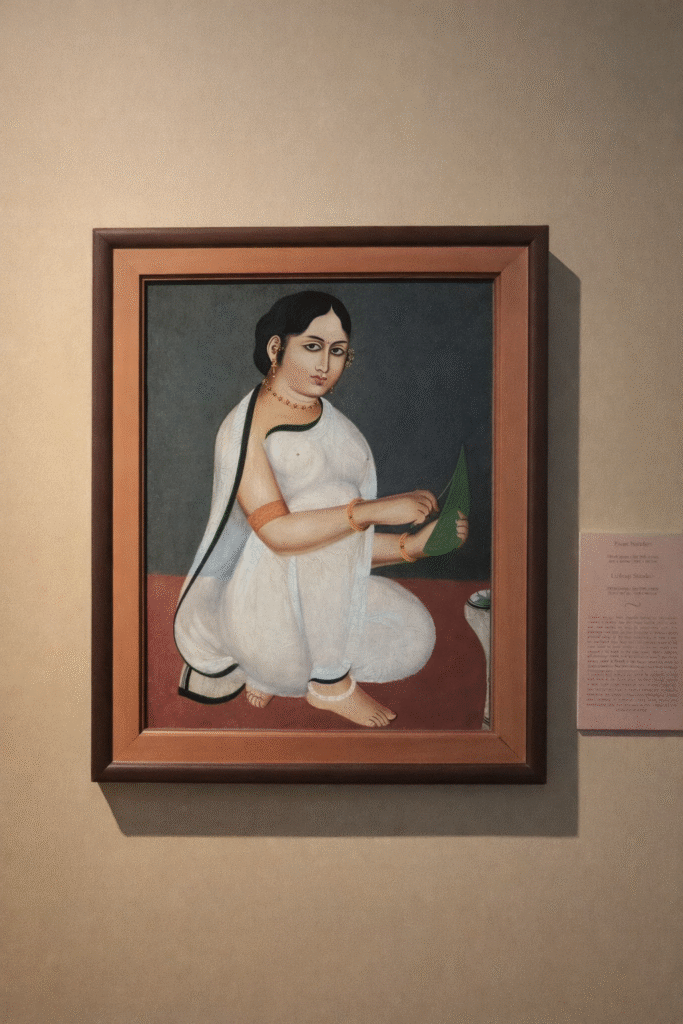
Kumoda Sundari
Taking inspiration from the European pin-ups of the 1890s, which were notorious for depicting theatre actresses in provocative poses, Bengali Babus commissioned Sundari paintings and prints. Sundaris were ostracised women, often victims of sexual violence or women who escaped from the clutches of Sati ( Self Immolation), but had to adhere to the faith beyond as a prostitute or courtesan. The Sundari paintings may depict a woman playing the tabla or violin, or just like a European Venus in her boudoir.
Here, Kumuda Sundari welcomes us into the closed space with her captivating eyes, confronting and inviting the voyeur as she applies slaked lime on a betel leaf. She is bedecked in gold ornaments yet wears a plain, translucent white saree, both reflecting her social status as a widow and offering the patron his coveted view. In a time when Bengali women started adopting blouses in the name of modesty, this was an artistic anomaly done only at the request of Babu. Like the female nude Venus hanging in the private quarters of a duke or king, these paintings might have hung in the bedroom of a so-called Bengali bhodrolok or gentleman.
One of the key reasons I chose these paintings is the act of making paan, which carries connotations dating back to the Kama Sutra. Paan, which has been seen as a symbol of prosperity in Indian culture, has been a medium of sexual consent referred to in the Kamasutra. Hence, the act of putting slaked lime on the betel leaf silently whispers about her sexual availability to the viewer. Apart from all the social connotations the painting carries, it is a splendid specimen of the amalgamation of Western vocabulary with the vernacular.
Cat with a prawn
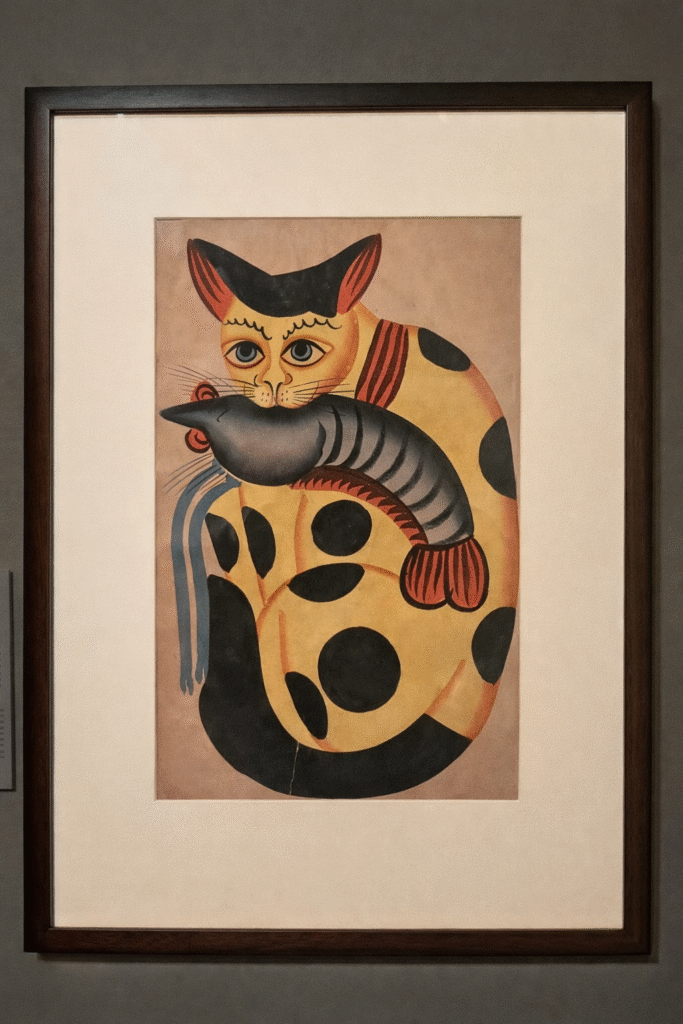
Water Colour on Paper
The relationship people share with their cats and dogs has long fueled conversation and shaped perception. Dogs are often cherished for their unwavering faithfulness, while cats are appreciated for their independence, returning to their owners as they wish and seeking affection on their own terms. This Kalighat painting embodies that spirit, capturing the enigmatic qualities that have fascinated cat enthusiasts for generations.
This polka-dotted yellow cat with sea blue eyes and almost human-like brows is the custodian of a prawn, a Bengali delicacy around which it curls its body. This cat is a symbol of the upper caste or the brahmanical society of Bengal at the turn of the 19th century. Brahmans who are called apagrihis, or the ones who shall not own land or wealth of their own, are said to survive on the charity of the wealthy in exchange for knowledge or rituals conducted for their master. However, there came a time when these brahmins commanded power over the wealthy on the grounds of caste supremacy, just like your pet cat had humble beginnings, but now it’s questionable if you adopted it or vice versa.
This image is a common icon in Kalighat paintings, later adopted by artists like Jamini Roy and K.G. Subramanium.
Bijoya
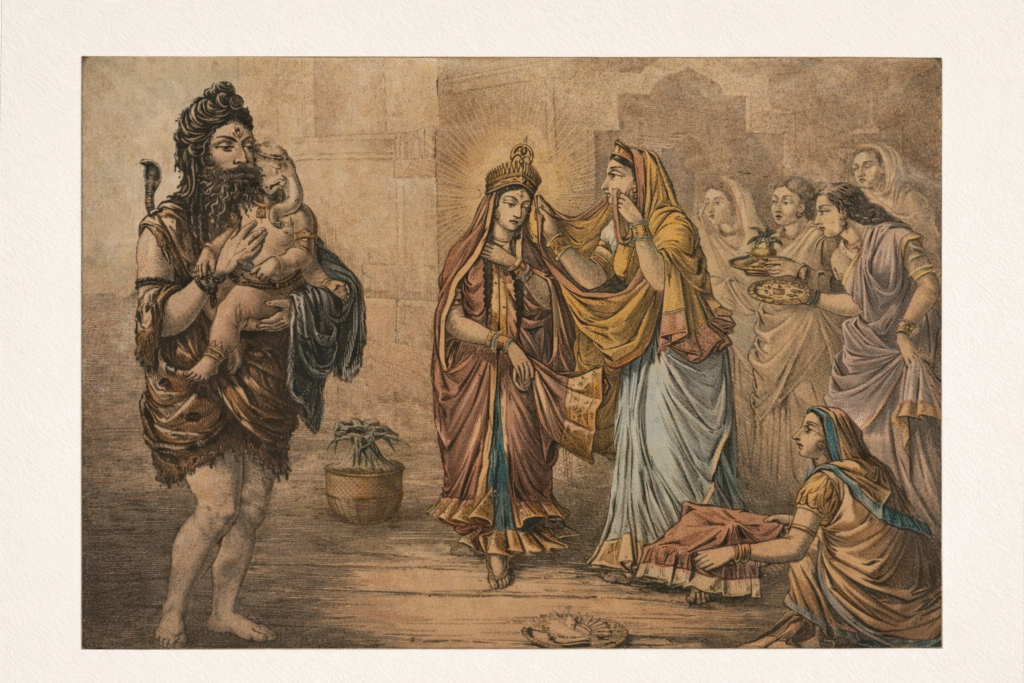
Chromolithograph ,14.5” X 18
This late 19th-century print by the prolific oil painter and portraitist Annada Prasad Bagchi was produced in one of the oldest Indian-run printing presses, the Calcutta Art Studio, which pioneered the printing of mythological scenes for the masses. The lithograph depicts what Bengali bards have been singing for ages. The all-powerful Goddess Durga returns to her maternal home during Durga Puja. On the day of Vijaya Dashami or Dusshera (for many), she has to return to Mount Kailasa to her beloved husband, Lord Shiva.
It is this episode that unfolds here. Parvati stands at the junction of her two worlds. Her maternal home, where this event unfolds, is a very domestic household setting with a l ot of women performing the Bodhon ritual, performed on Vijaya Dashami. The all-powerful Goddess has the luxury of being a little princess beside her mother. On the other side is a scruffier Lord Shiva holding Ganesha, a reminder of her simpler family at Kailasha, inhabited by all sorts of medicants, ghosts, beasts and bulls but no other women.
Like most other works of art from this exhibition,this print has very visible European influences. The Parvati at the centre of the print is modelled after the image of Mother Mary of Renaissance-era paintings and sculptures. The halo behind Parvati’s head, the crown, the slight tilt of her head in melancholy, like a Madonna & Christ image, the drape of Parvati’s attire, and the obsession with the pleats of a Classical biblical image. Does the Shiva with this beard remind you of the typical image of Moses receiving the 10 commandments?

Leave a Reply